


Pergola Brands: What Do You Get For Your Money?
Pergolas: Do you get what you pay for? What exactly are you paying for? And which price point is right for you? Read on to find out more.
Pergolas all look the same... or do they?
Louvred aluminium pergola prices vary hugely from manufacturer to manufacturer, from £1,000 to £100,000 or more. But to the untrained eye, there’s often little or no visual difference between a cheap model and an expensive one.
This article aims to summarise the key differences between the two ends of the pergola market – to enable you to make a more informed choice about which price and quality is right for you. It also highlights where the Grillo Pergola (produced and fitted by longstanding UK manufacturer Caribbean) fits in the market.
On this page:
Brand comparison
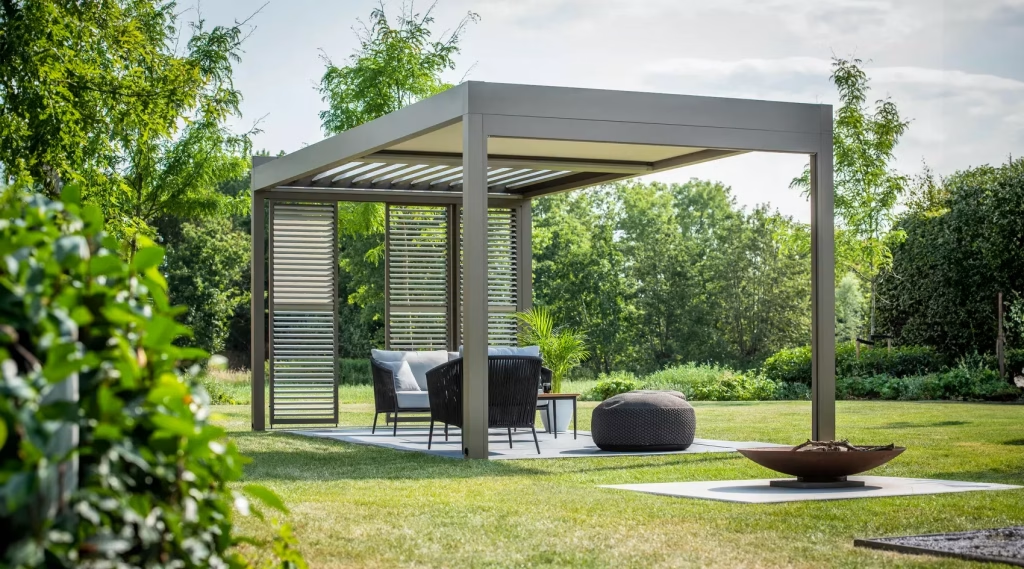
RENSON
£15k–£100k+
Widely recognised as the market leaders in Europe, Renson’s pergolas are excellent quality. They offer a vast range of options, with every pergola being custom and built-to-order – resulting in a higher price.
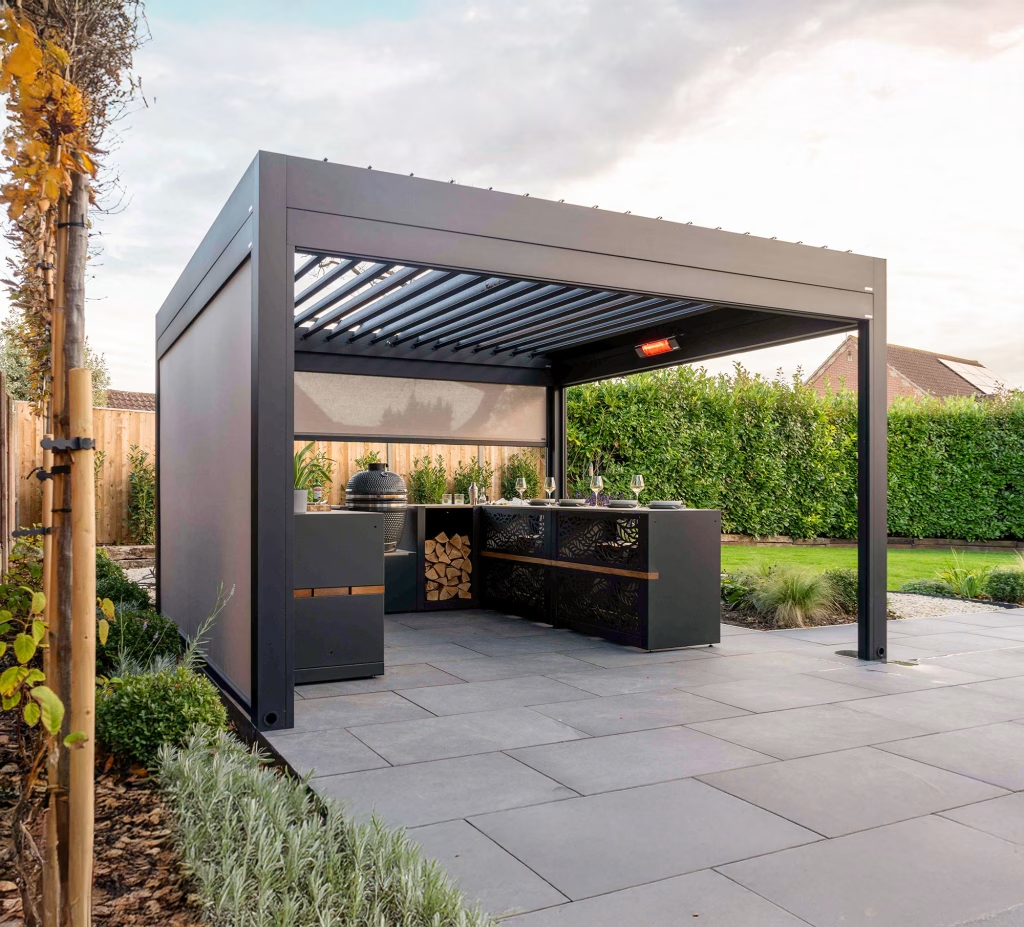
GRILLO, BY CARIBBEAN
£8k–£25k
Made by Caribbean – who have nearly 40 years’ experience – the Grillo Pergola is colour- and size-matched to our kitchens. Quality matches the best-in-class, and fewer options keep the price down.
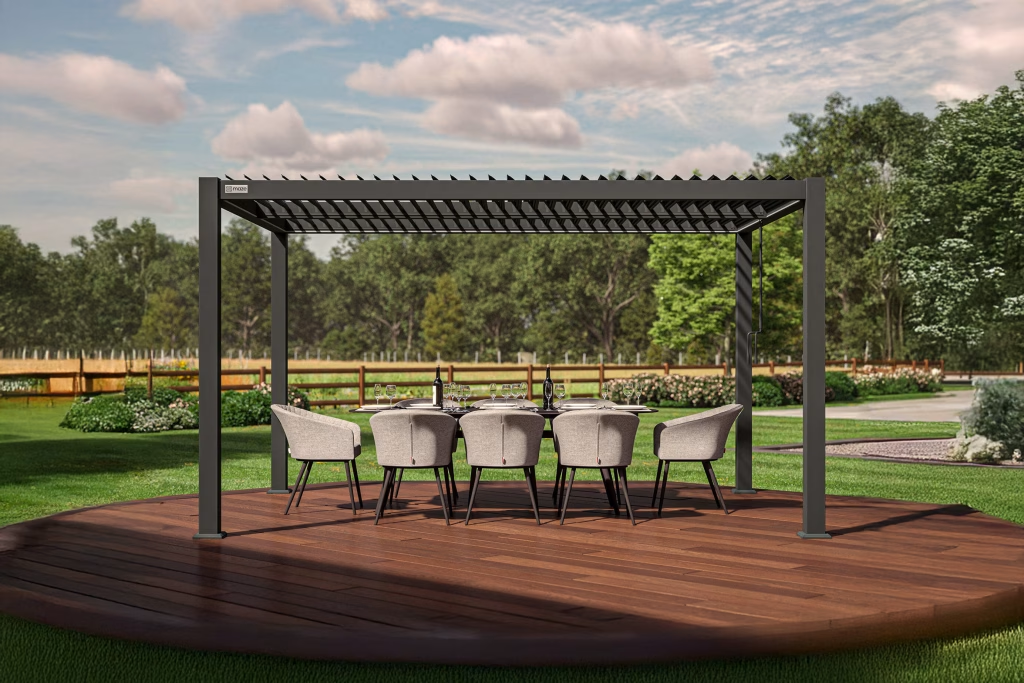
CHEAPER BRANDS
£1k–£8k
There are many brands in this category. For illustration, we’ve selected three well-known examples representing the low, mid, and high end of the price range – Maze Living, Suns Lifestyle, and Pergolux.
Pricing
Here we look at the price of some big brands in the UK louvred aluminium pergola market, what drives those prices, and where the Grillo Pergola fits.
Renson — £15,000 – £100,000+ excluding install
Renson — £15,000 – £100,000+ excluding install
The Belgian brand Renson is a major player in the UK/EU pergola market, with a global market share of around 13%. Their prices reflect the customisability of the product offering, with every pergola being built to order. If you need endless design and colour options, Renson might be for you.
Grillo — £8,500 – £25,000 installed
Grillo — £8,500 – £25,000 installed
The Grillo Pergola is made by Caribbean, a UK company with nearly 40 years experience manufacturing external shading systems. Their rigourous approach to quality, extreme weather testing, functionality and aesthetics ensures their products are at the top end of the market.
So why isn’t the price as high? In short, it comes down to economies of scale: The Grillo Pergola comes in a limited range of sizes, all in matching Grillo black and size-optimised for Grillo kitchens. This permits bulk manufacture of components, allowing us to offer a mid-range price on a top-end product.
Cheaper brands — Typically £750 – £7,500
Cheaper brands — Typically £750 – £7,500
Most brands around this price point are buying an off-the-shelf solution from an Asian manufacturer. Some, like Pergolux, will have worked extensively with the manufacturer to tailor their own range and options; others are simply buying and selling a complete pergola ‘kit’ with no design input at all. These routes offer economies of scale, but customisability options tend to be limited, and the pergolas tend to have a much lighter build quality and basic components.
Extreme Wind and Weather Testing
We don’t (often!) get hurricanes in the UK, but named storms with high wind speeds aren’t that uncommon. Quality manufacturers design and test pergolas for this weather… and they will tell you they’ve done so.
Renson — 75 – 100mph wind, 70 – 200kg/m² snow loading
Renson — 75 – 100mph wind, 70 – 200kg/m² snow loading
Renson publish a lot of technical testing data for their pergolas – including wind and snow loading – from multiple testing standards and bodies across multiple global regions. Rensons pergolas rated maximum windspeeds range from 75 – 100mph. Snow loading ranges from 70 – 200kg/m², with most at 100kg/m². Their fabric sidescreens (Fixscreen®) are rated to 37mph.
Grillo — 73mph wind, 100kg/m² snow loading
Grillo — 73mph wind, 100kg/m² snow loading
Grillo Pergolas (and all Caribbean pergolas) are wind tunnel tested to Beaufort 12 (hurrican-force, 73mph winds). The testing is undertaken by the renowned German independent quality standards body TÜV. Grillo sidescreens are tested to 31mph, beyond which they should be retracted. Snow loading is rated to 100kg/m², though snow isn’t a concern for most of the UK. For full details, see Caribbean’s Louvred Roof Wind FAQ here.
Cheaper brands — Wind & snow data usually unavailable
Cheaper brands — Wind & snow data usually unavailable
Most brands in this category don’t advertise (or test for) wind speed and snow loading data. Pergolux is a commendable exception, with this data clearly advertised: wind speeds of 62 –74mph, snow loadings of 100 – 150kg/m², and sidescreens up to 18mph.
Neither Suns Lifestyle or Maze Living offer any official wind or snow ratings online. Sometimes resellers will specify ratings, but these are often not corroborated by the manufacturers’ websites. For example, we found a reseller claiming a wind speed rating of Beaufort 4 (13 – 18mph) for Suns sidescreens, but the official website doesn’t mention this figure. No snow loading data was available from either resellers or official sources.
Strength and Materials
Above: A pergola failure due to lack of internal steel reinforcement.
Details of pergola construction can help fill in the gaps where testing data is missing. Almost all pergolas are made from aluminium, but the key issue here is that pergolas can have enormous forces exerted on joints and fixings in storm conditions. Unless the aluminium is thick enough or reinforced, the structure can fail.
Renson — Aluminium, heavy-duty, details unknown
Renson — Aluminium, heavy-duty, details unknown
Details of the construction of Renson pergolas are not publicly available, and the high degree of customisability likely means the exact construction varies from one design to the next.
Grillo — 4mm aluminium structure, steel reinforced
Grillo — 4mm aluminium structure, steel reinforced
Grillo Pergola legs are constructed of two parts. The inner structural leg is made from 4mm aluminium, 2 – 3x thicker than a typical aluminium pergola leg. The foot of the leg has a hidden base-plate, consisting of a 50cm galvanised steel post for rigidity. The corners are reinforced with a internal 3-axis corner brackets – also galvanised steel – extending 36cm into each leg and cross beam. This means the leverage force on the joints and feet is primarily borne by the steel, not the aluminium – making whole pergola hugely stronger and more rigid than an equivalent unreinforced frame.
Cheaper brands — 1–2mm aluminium structure
Cheaper brands — 1–2mm aluminium structure
Almost all brands in this category use 1–2mm extruded aluminium box section, but very few advertise an actual figure. Suns Lifestyle and Pergolux are exceptions, publishing figure of 1.5mm and 1.8–2.0mm aluminium thickness respectively.
Pergolux do have internal reinforcing on their newer pergolas, hence their impressive wind speed and snow loading rating. However, they are an exception – most cheaper brands simply bolt the posts directly to each other. Whilst extruded box section aluminium is quite rigid, the key to a strong pergola is how it’s joined at the corners and feet. Without reinforcing materials – or much thicker aluminium – a bolted 1–2mm box section corner will bend quite readily at the fixings under high wind loads. See the video in Installation below.
Installation
Installation is one of the last things many pergola buyers consider. But the quality of the install is as important as the quality of the pergola itself. Wherever you end up buying your pergola from, ensure the installers are experienced and competent!
Renson — Usually installed by Renson Ambassadors
Renson — Usually installed by Renson Ambassadors
Renson don’t install their own pergolas, instead using their Renson Ambassador network for professional installs. The warranty for workmanship lies with the Ambassador, not with Renson, so ask for details. Occasionally a tradesperson may do their own install to save cost, but this would invalidate the warranty.
Grillo — Installed by manufacturer, 5Y workmanship guarantee
Grillo — Installed by manufacturer, 5Y workmanship guarantee
Grillo Pergolas are installed by the manufacturer – Caribbean. Caribbean use their own team of salaried installers who only work on Caribbean’s products, backed by a 5-year guarantee on workmanship. An exception is where your landscaper is already a qualified installer for Caribbean – in this instance they may do their own install. Ask if you’re unsure.
Cheaper brands — Usually DIY or 3rd party install
Cheaper brands — Usually DIY or 3rd party install
Typically pergolas in this category are designed for self-install, or use third-party installers who specialise in a range of white-glove delivery/install services. This is a perfectly acceptable solution. But if you’re going this route, 1) make sure the installer you’re using has the competence and experience necessary, and 2) check if the warranty covers workmanship.
Pergolux’s approved and exclusive installer is the company Pergola Installations. Pergola Installations offer a 3-month warranty on workmanship.
Suns use their own install teams. Their warranty doesn’t specifically mention workmanship, but it’s worth asking. As they are both manufacturer and installer they carry the responsibility for the install.
Louvre Rotation
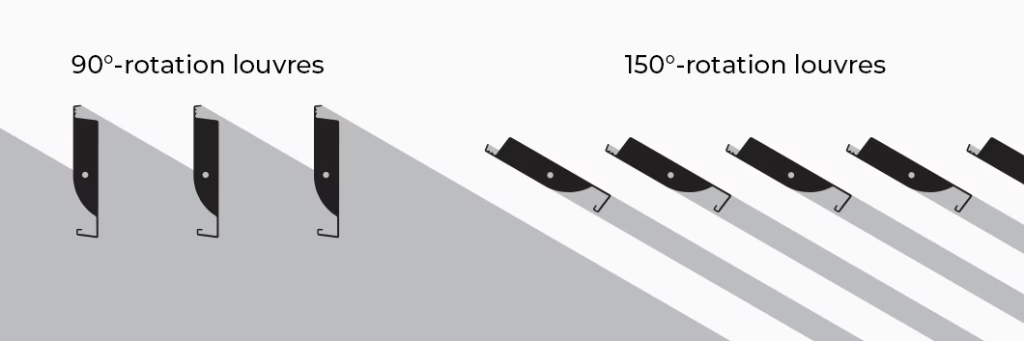
Above: Grillo louvres rotate to 150° – read on to find out why this matters.
Louvre rotation may not seem like a big deal, but if your louvres only rotate to 90°, you risk getting no sunlight at one end of the day. In addition, louvres that rotate further can be cleaned top and bottom from underneath. Beware of anyone claiming 180° rotation – this is impossible with overlapping louvres!
Renson — 150° louvre rotation
Renson — 150° louvre rotation
Renson’s louvres rotate to 150°. They also offer fully retractable louvre systems that move all the louvres to one end of the pergola, though these have a higher cost.
Grillo — 150° louvre rotation
Grillo — 150° louvre rotation
The Grillo Pergola’s louvres rotate to 150°. The Grillo Pergola can’t be had with a retractable system per se, but Caribbean (the manufacturer) do offer such systems for a significantly higher cost.
Cheaper brands — Rotation not advertised, often 90°
Cheaper brands — Rotation not advertised, often 90°
Many brands don’t advertise a rotation angle for their louvres, including Pergolux, Suns and Maze. Many cheaper brands louvres only rotate to 90°. See the top of this section for why that is a problem. One reseller claims 180° rotation – which is impossible with overlapping louvres.
Both Suns and Maze offer a retractable louvred roof model. Pergolux currently does not.
Drainage and Waterproofing
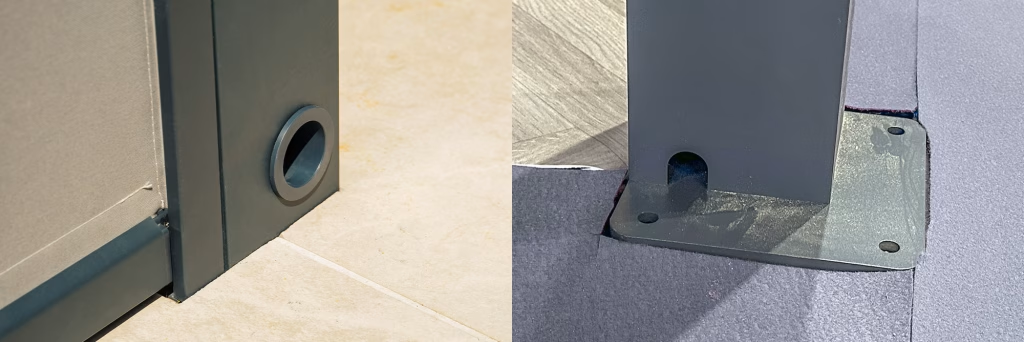
Above: Grillo piped internal drainage vs Pergolux non-piped internal drainage. Proper downpipes protect the inside of the frame from corrosion, and give the option of channelling the water to a soakaway or to under-patio drains.
All louvred pergolas feature louvres with drainage channels leading to a guttering system. There are two key differentiators to look out for: Firstly, the use of strong double-walled louvres that are prestressed to ensure a watertight interlocking connection – see Louvre Sizes and Prestressing below. Secondly, the use of proper downpipes within the legs, instead of simply letting the water drain down the inside of the aluminium. This can prevent hidden corrosion.
Renson — Piped internal drainage
Renson — Piped internal drainage
Renson have excellent water drainage control, with high quality louvres, anti-splash drainage channels, and internal drainpipes within the legs (protecting the inside of the leg from corrosion). Renson louvres are watertight when closed.
Grillo — Piped internal drainage
Grillo — Piped internal drainage
The Grillo Pergola has excellent water management. Rainwater is channeled to internal drainpipes within the legs (protecting the inside of the leg from corrosion). You can also choose which legs the water drains from, so you can have them draining away from your patio or into a nearby flowerbed. Grillo Pergola louvres are watertight when closed.
Cheaper brands — Open internal drainage
Cheaper brands — Open internal drainage
None of Pergolux’, Suns’ or Maze’ perogolas feature downpipes in the legs, rather simply letting water run down the inside of the leg itself. This is a common and cost-effective solution, but if poorly designed, it can expose internal fixings to water. This can lead to hidden corrosion and staining on the patio.
Language around waterproofing varies, with some being described as ‘weatherproof’ and others saying their materials are ‘100% weather resistant’.
Louvre Sizes and Prestressing
The best pergolas have long, wide, double-walled louvres. They are prestressed upwards slightly to counter sag, ensuring they interlock perfectly and remain watertight for years to come. But louvres like this require considerable skill and investment to manufacture. As a result, many cheaper brands use louvres that are short (less chance of warping means looser tolerances), narrow and single-walled (much cheaper to extrude) and thin (use less material). This limits pergola size: Sometimes pergolas will feature a split roof with a midspan support beam; other times they will have multiple legs along the length. It also means weaker louvres that are less watertight, and the narrow blade width can give more of a venetian blind effect – the more louvres you have, the less view you’ll have.
Renson — 23cm blade width, 48mm thick, prestressed
Renson — 23cm blade width, 48mm thick, prestressed
Renson use large 23cm blade width louvres, double-walled and 48mm thick. Like Grillo louvres, these are prestressed to ensure sag can be controlled and proper waterproofing can be achieved.
Grillo — 23cm blade width, 43mm thick, prestressed
Grillo — 23cm blade width, 43mm thick, prestressed
The Grillo Pergola has broad 23cm blade width louvres, double-walled and 43mm thick. The louvre blades are prestressed in manufacture with a very slight upward curve. This counters any sag once installed and ensures tight interlocking for proper waterproofing.
Cheaper brands — Often 16cm blade width, 20mm thick
Cheaper brands — Often 16cm blade width, 20mm thick
Little information is available on louvre blade specifications for brands in this category. Generally, more affordable pergolas use a narrower 16cm, single-walled blade of around 20mm thickness. Such louvres are typically unstressed, with Pergolux stating “some waviness when closed is normal”. (Note some Pergolux models have double-walled and wider louvres, though it’s unclear which models). Suns and Pergolux louvres are typically full-span, whereas Maze louvres vary from product to product.
Motorisation and Reliability
Whilst manual systems exist, many people prefer to go for a fully-motorised system such as those offered by leading brands. Look out for warranties on electronics as this is often the first thing to go wrong – see Aesthetics and Design below for one reason why.
Renson — Somfy electronics, 5-year warranty
Renson — Somfy electronics, 5-year warranty
Renson use class-leading Somfy electronics utilising app, remote or smart hub control. This can be used to control all electronic components – from louvres and screens to lighting and heaters. Renson offer a 5 Year Warranty specifically on automation and electronics.
Grillo — Somfy electronics, 5-year warranty
Grillo — Somfy electronics, 5-year warranty
The Grillo Pergola also uses class-leading Somfy electronics, with app or remote control. This is used for controlling louvres, sidescreens, lighting and heating. The electronics have a 5 Year Guarantee covering all integrated circuit boards, transformers, receivers and remote controls.
Cheaper brands — Unbranded electronics, warranty varies
Cheaper brands — Unbranded electronics, warranty varies
Not all brands in this category are motorised, and those that are typically use an unbranded system. The warranty on this varies, and may not be specified: Suns offer a 3-year warranty specifically on electronics, and Pergolux a 2-year one. Maze offers a general 2-year warranty that covers ‘defects in materials’, and doesn’t mention electronics.
Aesthetics and Design
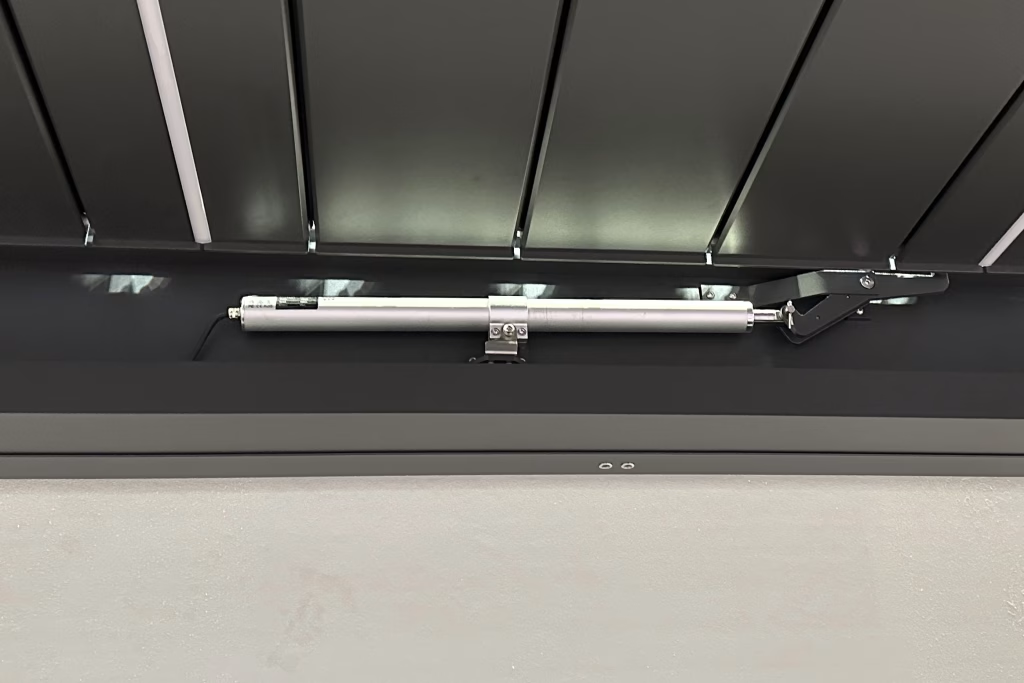
Above: Exposed motors aren’t just unsightly – they’re exposed to the elements, and will almost always have a shorter warranty.
Sleeker design doesn’t just mean a pergola looks neater on your patio, it also means the manufacturer has gone to the effort of concealing motors and fixings within the frame – where they’re protected from the weather.
Renson — Sleek, concealed motors, vast range of design options
Renson — Sleek, concealed motors, vast range of design options
Rensons pergola designs are sleek with concealed motors and no visibile fixings. They offer a vast range of design, colour and material options, with each pergola being made-to-order to your exact specification. Nothing is off the shelf – it’s this customisability that drives the significant price difference between Grillo and Renson.
Grillo — Sleek, concealed motors, colour & size-matched to Grillo
Grillo — Sleek, concealed motors, colour & size-matched to Grillo
The Grillo Pergola has a very sleek design with concealed motors, no visible fixings, and a completely hidden baseplate. The pergola is deliberately offered with a narrow range of core options in order to keep the price as low as possible without compromising on quality. The textured, black powder coat is identical to that on a Grillo kitchen, and the sidescreens are a premium Austrian-made Sattler Twilight performance fabric in buff. Other standard options are powerful IR-heaters and LED-lighting integrated into the louvres.
Cheaper brands — Exposed motors and fixings, smaller spans
Cheaper brands — Exposed motors and fixings, smaller spans
These features vary hugely depending on manufacturer, and we’d recommend viewing in person to see the differences. Look out for exposed motors (used by all 3 brands here) – these will generally have a shorter warranty compared to motors that are concealed within the frame. Also look out for visible fixings and slightly untidy features like exposed baseplates. Design options are likely to be limited, and narrower structural elements mean smaller spans between legs – so if you want a large pergola it could have multiple supports along its length. Fabrics are often textilene.
Pergola Warranties
Note: For install/workmanship warranties, see the Installation section ↑ above.
Read the available warranty documentation in detail before buying a pergola, and also search the reviews for customers who’ve had problems. This may shed light on what can fail and, crucially, how the company responded. Bear in mind that almost all warranties will have exclusions for extreme weather, but the advertised windspeed ratings are a good indication of what manufacturers might consider to be ‘extreme’.
Renson — 10Y structure, 5Y electronics, 5Y sidescreens
Renson — 10Y structure, 5Y electronics, 5Y sidescreens
A 10-year structural warranty is the standard for the top end of the market. In addition to the figures mentioned above, there’s a 2-year warranty on lighting and heating.
Grillo — 10Y structure, 5Y electronics, 5Y sidescreens
Grillo — 10Y structure, 5Y electronics, 5Y sidescreens
The Grillo Pergola warranty offers 10 years on the framework and powder coating, 5 years on the Somfy electronics, 5 years on the Sattler fabrics (covering fade, stretch and tear), and 3 years on lighting, heating and any bespoke brackets and fixtures.
Cheaper brands — 2–10Y* structure, 0–3Y electrics, 1–2Y s/screens
Cheaper brands — 2–10Y* structure, 0–3Y electrics, 1–2Y s/screens
Obviously warranties vary hugely, but here’s a summary of the 3 brands:
*Pergolux have a 10Y warranty on the structure, but (unusually) only 2Y on moving parts – which includes louvres, hinges and linkages. Electronics have a 2Y warranty and sidescreens are not mentioned.
Suns generally offer 5Y structural, 3Y electronics and 2Y sidescreens. It’s not clear if lighting and heating are covered – ask for the specifics before ordering.
Maze offer 2Y structural and 1Y accessories (inc. sidescreens). It’s not clear if electronics are covered, as the warranty only covers ‘defects in materials’.
Summary: it's the inside that counts
As with most things in life, you get what you pay for. Pergolas tend to ‘look the same’ because they all share the same basic structure – an extruded, powder-coated aluminium frame.
But it’s what’s hidden inside the structure that makes the biggest difference. Things like steel reinforcing, extreme-weather testing, weatherproofing, quality of motorised components – these things can make the difference between a pergola that lasts, and one that turns to twisted metal the first time it meets a named storm. And they’re usually the difference between a 5 or 10 year warranty, and a 1 or 2 year one.
Then there are the non-critical differences – things like hidden fixings, piped internal guttering, full-motorisation, fully-rotating louvres etc. Make sure you consider all these things when comparing pricing. And don’t forget to check Trustpilot and Google for reviews!
Last, but definitely not least, check the installation details: Who actually installs it? Is their work covered by a warranty? A pergola is only as good as its installation.